What we can do as parents, teachers, and adults to protect our kids: 1.Educate your kids about human trafficking.
That it is here, what it looks like and to talk to you or another
responsible adult if they think they see it. If they are able, have them
read In Our Backyard. It will help them recognize the indicators. 2. Communicate with your kids, and let them talk to you without judgment.They
need to know they are safer with you than anywhere else. One rule we
had with our children was that if they did something wrong and they told
us before we found out, they might have some consequences but their
punishment would be less than if we found out another way.
3. Technology is a big part of how sex trafficking happens with youth.Know your kid’s passwords, know what is on their phone.
A good rule is “as long as you live under our roof, we have access to
passwords, emails, texts, etc.” Your child’s privacy is important but so
is their safety. If you talk to parents whose children have been sex
trafficked, without exception, they will all tell you they wish they had
monitored their computers, cell phone and activities on social media.
4. Technological devices now exist which include: GPS tracking devices
which can be placed on phones, clothes, and in backpacks which help
parents and authorities track your child and find them when they first
go missing. DNA scent kitswhich can be used to help authorities and dogs track a scent trail. 5.Know your kid’s friends.Have
them over to your home. Feed them a pan of brownies, a batch of cookies
and sit down and talk with them. Know where they hang out and what they
are like. 6.Get youth involved in positive things,community groups, sports, music, community service, and church youth groups. Surround them with positive peer pressure.
Gang Involved-Sex Trafficking
Watch this online training to learn how gangs are trafficking women and girls for sex.
Indicators of Human Trafficking in the Lives of Those Around You:
Situation: Teens whose circle of friends change completely and their new friends may have a gangster or provocative look Solution: Know your kid’s friends, don’t be afraid to be the parent and say no.
Situation: Teen receives an offer that
sounds too good to be true — a dream life, fancy cars, fancy clothes,
fast living for seemingly nothing Solution:
Keep in good communication with your children, do things with them to
build relationship and help them understand it’s important to discuss
with you any opportunities such as the one in this situation.
Situation: Kids have increased and unexplained absences from school. Solution:Work
with school to ascertain what is happening and cooperate with the
school so you can find your child immediately in an unexplained absence.
Situation: Kids are bringing home new cell phones as gifts from a new friend. Solution: Find out where the cell phones came from, confiscate them, and contact authorities if necessary.
Situation: Girls, especially teens with a new boyfriend who may be several years older Solution:
Restrict contact with him. If that doesn’t work consider relocating
your child to protect them. (You may contact IN OUR BACKYARD) if you
need information about relocation services.
Situation: Kids/teens come home with unexplained money or gifts. Solution:
Find out where they came from. Bring in outside help from counselors,
relatives or others who can help. Don’t ignore or hide this to save
reputation. Get help!
Situation: New tattoos Solution: Find out who did the tattoo, find out who was with them for the tattoo and what does it mean? Who else has the same tattoo?
Sen. David Farnsworth, R-Mesa. Photo by Gage Skidmore | Flickr/CC BY-SA 2.0
A
conservative Republican senator who is convinced that the Arizona
Department of Child Safety is facilitating the global sex trafficking of
children removed from negligent parents called the police on one of his
GOP colleagues, alleging that she threatened his life.
Sen.
David Farnsworth, a Republican from Mesa, filed a report with the
Arizona Department of Public Safety this week accusing Sen. Kate Brophy
McGee, R-Phoenix, of threatening him if he didn’t stop investigating the
outrageous claim. The news was first reported by Yellow Sheet Report, a high-priced insider newsletter aimed at lobbyists and government officials.
Farnsworth told Yellow Sheet
that he has been looking into how DCS “lost” more than 550 children
last year, roughly half of whom are categorized as either runaways or
otherwise missing. The rest appear to be flagged for paperwork errors.
He
said he fears the children have been abducted and sold into a global
sex trafficking ring, and said he has been holding meetings with DCS,
critics of the agency and fellow lawmakers, including Brophy McGee.
Farnsworth acknowledged his beliefs were outlandish, but he said it’s not a conspiracy theory. He told Yellow Sheet
that he didn’t believe DCS officials were actively selling children
into sexual slavery, but that they are being lax at protecting children
from predators who will do so.
While
he said he hopes his meetings ultimately prove him wrong, Farnsworth
said he is more convinced than ever that Arizona children removed from
their parents and put into group homes or foster homes are being
sex-trafficked, even though he told Yellow Sheet he has turned up no evidence.
“When
I first heard about this, I believed that children from Arizona (DCS)
were ending up in sex trafficking. Now, after the research I’ve done,
I’m confident of it,” he told Yellow Sheet. “But I can’t prove it.”
Farnsworth also alleged that two former Republican state senators from other states who were killed within days of each other
earlier this year were “executed” because they were investigating links
between their own states’ child protective agencies and global sex
trafficking rings.
There
is no evidence that either ex-legislator was murdered for that reason.
Linda Collins-Smith, a former senator from Arkansas, was killed by a close friend and former campaign aide. And Jonathan Nichols, a former senator from Oklahoma, died by suicide.
The
dispute between Farnsworth and Brophy McGee stems from what she said
was a conversation in which she told her colleague that both she and her
husband were concerned for her safety after some of Farnsworth’s allies
in the child-sex-ring investigation began harrassing her and spreading
rumors that she and others are involved in illicit child kidnapping schemes.
Brophy McGee told the insider publication that Farnsworth’s compatriots
are “unbalanced” and have forced her to have Senate security guards
escort her to and from meetings about DCS, but Farnsworth has been
unconcerned.
Bur Farnsworth told Yellow Sheet
that, while he initially didn’t take Brophy McGee’s comments seriously,
he decided to file a complaint with DPS because the “best deterrent to a
threat is for more people to be aware of it.”
new conspiracy theory surrounding products advertised by the home
goods and furniture seller Wayfair now joins previous unsubstantiated
allegations like Pizzagate regarding worldwide pedophilic sex
trafficking among the economic elite.
The Wayfair conspiracy
theory that became a social media sensation on Friday began with a post
to the Conspiracy subreddit, which promotes user-submitted conspiracy
theories, many thinly evidenced or unevidenced, to more than a million
subscribers.
"Is it possible Wayfair involved in Human trafficking with
their WFX Utility collection? Or are these just extremely overpriced
cabinets? (Note the names of the cabinets) this makes me sick to my
stomach if it's true," redditor PrincessPeach1987 posted on Thursday,
alongside a screenshot from Wayfair's mobile website featuring four
storage cabinets—products named Neriah, Yaritza, Samiyah and Alyvia—that
cost between $12,699.99 and $14,499.99.
Newsweek reached out to Wayfair regarding the human trafficking
conspiracy theories, including a request for an explanation of the
high-priced items. The company provided this statement in response:
Ads by scrollerads.com
"There
is, of course, no truth to these claims. The products in question are
industrial grade cabinets that are accurately priced. Recognizing that
the photos and descriptions provided by the supplier did not adequately
explain the high price point, we have temporarily removed the products
from site to rename them and to provide a more in-depth description and
photos that accurately depict the product to clarify the price point."
The
conspiracy theory has been elaborated on other social media platforms,
particularly Twitter, expanding on the original post and its assertion
that very expensive or overpriced cabinets with human names is in itself
evidence of human trafficking conducted more or less in the open, with
Wayfair offering humans for sale under the guise of selling cabinetry.
In chat conversations with Newsweek,
PrincessPeach1987 described seeking out garage storage with their
husband when they came across the expensive cabinet listings. While they
at first surmised that they may have stumbled across unlisted drop
shipping sales, Facebook posts also suspicious of the pricey listings
made them more inclined to listen to their suspicions that there may be
something more to the listings.
PrincessPeach1987, who declined to
reveal their non-redditor identity, described themselves as "involved
in a local organization that helps victims of human trafficking," which
has led her to be "suspicious most of the time now." They characterized
their Reddit post as less of a direct accusation and more of an effort
to "see if anyone else had more details."
Prominent arrests—like
that of Jeffrey Epstein for the alleged trafficking and sexual assault
of underage girls—have shown that extensive pedophilia networks do
exist, but the "details" of the Wayfair theory do not make a credible
case.
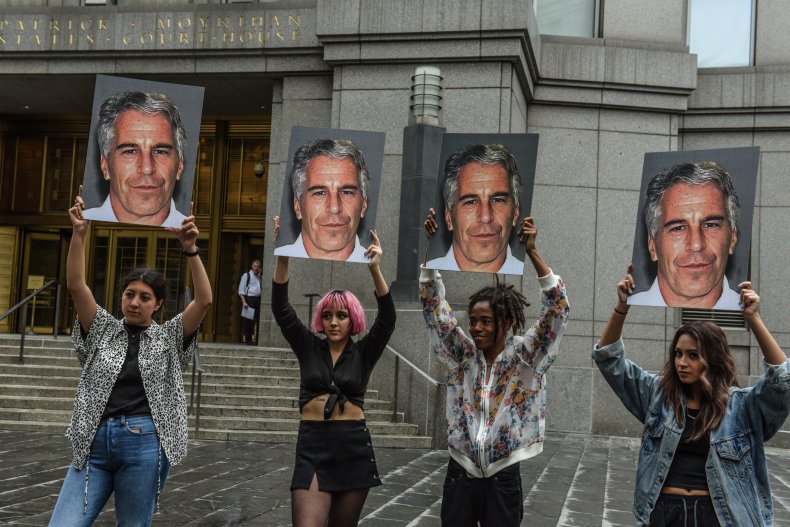
Protestors hold up images of Jeffrey Epstein outside
of a federal courthouse in New York City after his 2019 arrest. Before
his death in federal detention, Epstein was charged with one count of
sex trafficking of minors and one count of conspiracy to engage in sex
trafficking of minors.Photo by Stephanie Keith/Getty Images
Subsequent elaborations on the theory included a user review
on the Wayfair website for a previously unrelated, $5,000 fireproof
filing cabinet, which included a 2016 user review from someone in Walnut
Creek, California. The San Francisco exurb, with a population of more
than 70,000, was also the location of a February arrest for human
trafficking, child pornography and attempted kidnapping, which was
allegedly connected to a wider child sex trafficking ring. "Walnut
Sauce" is also an alleged code word central to Pizzagate conspiracy
theories.
Supporters of the theory have also urged skeptics to use
a Russian search engine to search for the stock keeping unit number
(SKU) associated with various Wayfair products, which returns image
results full of children in bathing suits. However, none of the SKU
searches return images of a single child, which would seem to run
counter to the implication that the Wayfair SKUs secretly provide data
regarding the specific child to be purchased. In addition: following the
search engine instructions with any random string of numbers returns
the exact same results.
Supporters of the theory have also drawn
connections to June 2019 protests by Wayfair employees, which objected
to the company selling furnishings to a Texas detention facility for
migrant children. The facility subsequently closed. However, protesting
Wayfair employees never mentioned setting up public listings for humans.
Still,
the Wayfair conspiracy theory has begun to take on a life of its own on
social media and will likely become a part of the extensive mythology
regarding child sex trafficking brought to national prominence in 2016
with Pizzagate.
Pizzagate alleged that a child sex and human trafficking
ring operated by high-ranking Democratic Party officials was run, in
part or completely, through the non-existent basement of a Washington
D.C. area pizza shop. While easily debunked "evidence" began to pile up—Newsweek previously documented
how transgressive public art, including footage from concerts, was
falsely recontextualized as secret Satanic rituals—the crux of the
claims relied on emails stolen from the personal account of Hillary
Clinton campaign manager John Podesta and published by WikiLeaks in
2016.
While the so-called "Podesta emails" contained multiple newsworthyrevelations—including the content of speeches Clinton delivered to
Goldman Sachs and the leak of questions to the Clinton campaign in
advance of a CNN town hall with 2016 Democratic primary opponent Bernie
Sanders—Pizzagate was built on the unsubstantiated claim that certain
words within the emails were in fact coded allusions to child sex
trafficking. In the arbitrary associations developed by conspiracy
theorists, various food words, including "cheese," "map," "walnut sauce"
and, of course, "pizza," were actually coded indications of people's
preferred child victims.The Wayfair conspiracy theory shares a similar pattern, drawing arbitrary inferences without any evidence.
Child sex trafficking refers to the recruitment, harboring,
transportation, provision, obtaining, patronizing, or soliciting of a
minor for the purpose of a commercial sex act. Offenders of this crime
who are commonly referred to as traffickers, or pimps, target vulnerable
children and gain control over them using a variety of manipulative
methods. Victims frequently fall prey to traffickers who lure them in
with an offer of food, clothes, attention, friendship, love, and a
seemingly safe place to sleep. After cultivating a relationship with the
child and engendering a false sense of trust, the trafficker will begin
engaging the child in prostitution, and use physical, emotional, and
psychological abuse to keep the child trapped in a life of prostitution.
It is common for traffickers to isolate victims by moving them far away
from friends and family, altering their physical appearances, or
continuously moving them to new locations. Victims are heavily
conditioned to remain loyal to the trafficker and to distrust law
enforcement. No child is immune to becoming a victim of child sex
trafficking, regardless of the child’s race, age, socioeconomic status,
or location, and every child involved in this form of commercial sexual
exploitation is a victim.
Technological advances, in particular the Internet and
mobile devices, have facilitated the sex trafficking of children by
providing a convenient worldwide marketing channel. Individuals can now
use websites and social media to advertise, schedule, and purchase
sexual encounters with minors. The Internet and mobile devices also
allow pimps and traffickers to reach a larger clientele base than in the
past, which may expose victims to greater risks and dangers.
Child sex trafficking investigations present unique
challenges to law enforcement and require a robust multijurisdictional
response, with multiple agencies playing a critical role in ensuring the
protection of victims and effective prosecution of offenders. The
method by which most traffickers identify, recruit, market, and maintain
their victims results in a unique combination of sustained violent
criminal behavior with reluctant victims and witnesses. Although
interviews of sex trafficking victims frequently identify traffickers
and other accomplices, some child victims may resist identifying their
traffickers because of fear or other means of manipulation that the pimp
has exercised over them. Furthermore, the victim may only know their
traffickers’ street name and cannot fully identify their traffickers.
Child sex trafficking victims are often not recognized as
victims and may be arrested and jailed. The dangers faced by these
children—from the traffickers, their associates, and from customers—are
severe. These children become hardened by the treacherous environment in
which they must learn to survive. As such, they do not always outwardly
present as sympathetic victims. They also frequently suffer from
short–term and long–term psychological effects such as depression,
self-hatred, and feelings of hopelessness. These child victims also
need specialized services that are not widely available given they often
have illnesses, drug addictions, physical and sexual trauma, lack of
viable family and community ties, and total dependence—physical and
psychological—on their abusers.
For more information, see Federal Law on Child Sex Trafficking. International Sex Trafficking of Minors
One form of sex trafficking involves the cross border
transportation of children. In these situations, traffickers recruit and
transfer children across international borders in order to sexually
exploit them in another country. The traffickers can be individuals
working alone, organized crime groups, enterprises, or networks of
criminals working together to traffic children into prostitution across
country lines.
This form of sex trafficking is a problem in the United
States, and recovered victims originate from all over the world,
including less-developed areas, such as South and Southeast Asia,
Central America, and South America, to more developed areas, such as
Western Europe. Once in the United States, a child may be trafficked to
any or multiple states within the country. These victims are often
trafficked far from home, and thrown into unfamiliar locations and
culture. They may be given a false passport or other documentation to
conceal their age and true identity. They may also struggle with the
English language. All these factors make it extremely difficult for
these children to come forward to law enforcement.
In addition, many foreign victims originate from nations that
suffer from poverty, turbulent politics and unstable economics. Children
from these countries are seen as easy targets by traffickers because
they face problems of illiteracy, limited employment opportunities, and
bleak financial circumstances in their home country. It is not
uncommon for a foreign victim to be coerced by a trafficker under false
pretenses. The child is told that a better life or job opportunity
awaits them in the United States. However, once in the United States
they are introduced into a life of prostitution controlled by
traffickers. Domestic Sex Trafficking of Minors
The United States not only faces a problem of foreign
victims trafficked into the country, but there is also a homegrown
problem of American children being recruited and exploited for
commercial sex. Under federal law, a child does not need to cross
international or even state borders to be considered a victim of
commercial sexual exploitation, and unfortunately, American children are
falling victim to this crime within the United States.
Pimps and traffickers sexually exploit children through
street prostitution, and in adult night clubs, illegal brothels, sex
parties, motel rooms, hotel rooms, and other locations throughout the
United States. Many recovered American victims are street children, a
population of runaway or throwaway youth who often come from low income
families, and may suffer from physical abuse, sexual abuse and family
abandonment issues. This population is seen as an easy target by pimps
because the children are generally vulnerable, without dependable
guardians, and suffer from low self-esteem. Victims of the prostitution
of children, however, come from all backgrounds in terms of class, race,
and geography (i.e. urban, suburban, and rural settings).
Often in domestic sex trafficking situations, pimps will make
the child victim feel dependent on prostitution for life necessities and
survival. For example, a pimp will lure a child with food, clothes,
attention, friendship, love, and a seemingly safe place to stay. After
cultivating a relationship with a child and engendering a false sense of
trust, the pimp will begin engaging the child in prostitution. It is
also common for pimps to isolate victims by moving them far away from
friends and family, altering their physical appearances, or continuously
moving victims to new locations. In many cases, victims become so
hardened by the environment in which they must learn to survive that
they are incapable of leaving the situation on their own. Child Victims of Prostitution
The term prostitution can delude or confuse one’s
understanding of this form of child sexual exploitation. It is important
to emphasize that the children involved are victims. Pimps and
traffickers manipulate children by using physical, emotional, and
psychological abuse to keep them trapped in a life of prostitution. It
is not uncommon for traffickers to beat, rape, or torture their victims.
Some traffickers also use drugs and alcohol to control them.
Technological advances, in particular the Internet, have
facilitated the commercial sexual exploitation of children by providing a
convenient worldwide marketing channel. Individuals can now use
websites to advertise, schedule, and purchase sexual encounters with
minors. The Internet and web-enabled cell phones also allow pimps and
traffickers to reach a larger clientele base than in the past, which may
expose victims to greater risks and dangers.
In addition, many child victims suffer from physical ailments,
including tuberculosis, infections, drug addition, malnutrition, and
physical injuries resulting from violence inflicted upon them. Venereal
diseases also run rampant. Children may also suffer from short–term and
long–term psychological effects such as depression, low self-esteem,
and feelings of hopelessness. CEOS’s Role
CEOS attorneys work with the High Technology Investigative
Unit (HTIU), the Federal Bureau of Investigation (FBI), United States
Attorney´s Offices around the country, and other state and local parties
to investigate and prosecute cases arising under federal statutes
prohibiting the prostitution of children. CEOS works to not only punish
and jail offenders, but to protect the rights and welfare of the
children involved.
In addition, CEOS maintains a coordinated, national-level law
enforcement focus, and helps coordinates nationwide and international
investigations and initiatives. CEOS attorneys travel all over the
country to conduct trainings for investigators, law enforcement
personnel and others involved in efforts to eradicate this crime.
Moreover, CEOS designs, implements, and supports law enforcement
strategies, legislative proposals, and policy initiatives relating to
federal laws prohibiting the prostitution of children.
 1. Educate your kids about human trafficking.
That it is here, what it looks like and to talk to you or another
responsible adult if they think they see it. If they are able, have them
read In Our Backyard. It will help them recognize the indicators.